
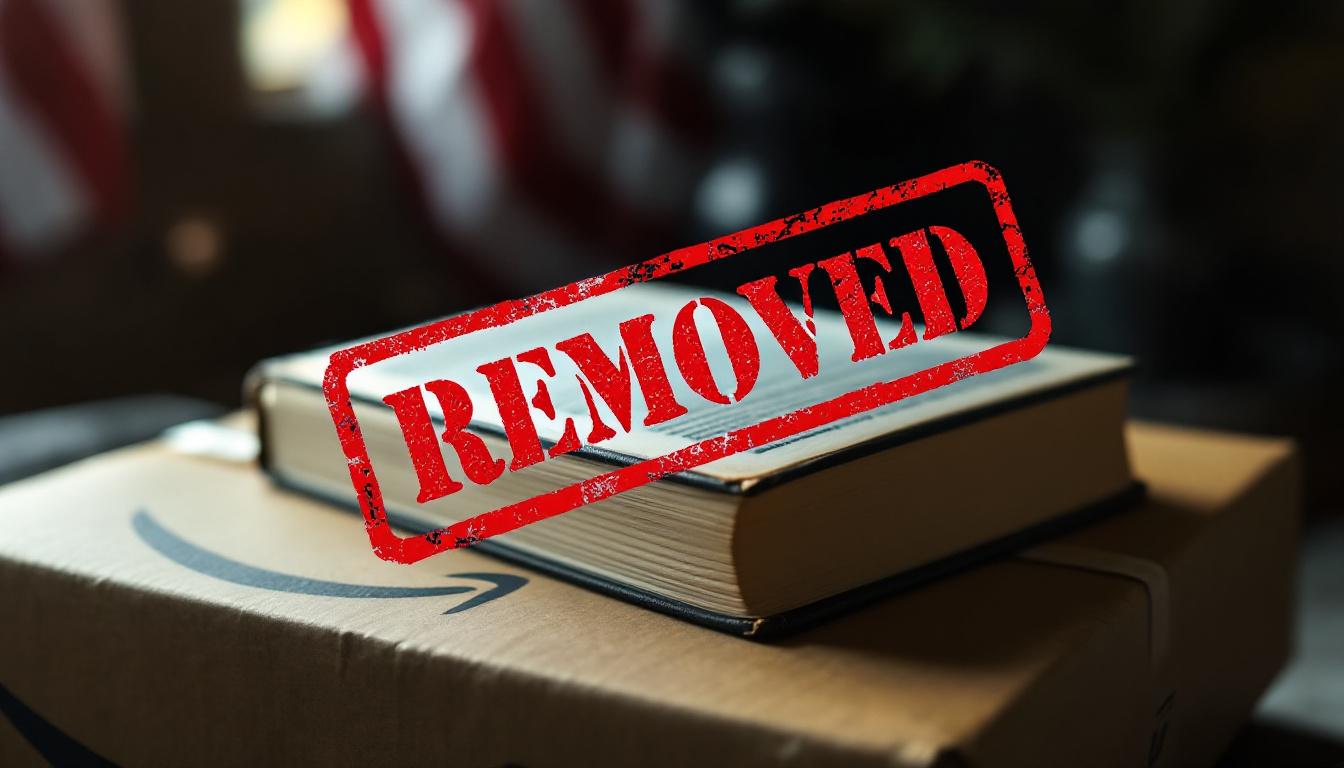
So here’s where we are as a country. Amazon — the company that will happily sell you a how-to guide on Marxism, a Che Guevara onesie for your baby, and enough Chinese-made junk to fill a landfill — decided last Friday that a 53-year-old French novel about the dangers of mass immigration was just too offensive for your delicate American eyes. The book is called The Camp of the Saints by Jean Raspail, and Amazon ripped it right off their shelves like it was radioactive. No warning. No explanation. Just gone.
Because nothing says “land of the free” like a trillion-dollar corporation deciding which fiction you’re allowed to read. Welcome to 2026, folks, where a novel written in 1973 is apparently more dangerous than Democrats open borders fantasy.
Let’s walk through what happened, because the timeline tells you everything you need to know about who’s really pulling the strings.
Vauban Books published a fresh English edition of The Camp of the Saints back in July 2025. The novel — a dystopian story about a massive wave of migrants flooding into Europe and the Western civilization that’s too paralyzed by guilt to defend itself — had been selling beautifully for eight months. Twenty thousand paperback copies. A 4.8-star rating from actual customers. People were buying it, reading it, and loving it. Which, of course, was the problem.
Then on Thursday, New York Magazine ran a hit piece on Vice President Vance that just happened to reference the book. One day later — one day — Amazon nuked the paperback listing, citing a violation of their “offensive content” policy. By Saturday morning, they’d killed the hardcover too. The Kindle and audiobook survived, presumably because Amazon’s censorship algorithm hadn’t gotten around to those yet.
Now think about that for a second. A book sits on Amazon for eight months. Sells twenty thousand copies. Nearly perfect customer reviews. Then a liberal magazine name-drops it in an attack piece on the Vice President, and poof — it’s “offensive content” overnight. That’s not a coincidence, folks. That’s a hit job with a digital paper trail.
Vauban Books came out swinging. They pointed out that Amazon never told them which portions of the book were supposedly offensive. Never told them to whom it was offensive. Just flipped the switch and memory-holed a half-century-old piece of literature because some editor at a Manhattan magazine decided it made the wrong people look bad.
And who does it make look bad? Well, that’s the whole game, isn’t it?
Raspail wrote The Camp of the Saints in 1973 as a warning. It’s fiction — a thought experiment about what happens when Western nations lose the will to defend their own civilization against an overwhelming wave of mass migration. It’s not a policy paper. It’s not a manifesto. It’s a novel. The kind of thing we used to believe free societies could handle without having a nervous breakdown.
But in 2026, the book reads less like dystopian fiction and more like a documentary. Millions of unvetted migrants pouring across borders. European cities transformed beyond recognition. American towns buckling under the weight of a crisis their own government created. The left spent years telling us this was all a conspiracy theory — and now that reality has caught up to the fiction, they don’t want you reading the fiction.
That’s what this is really about. It’s not that the book is “offensive.” It’s that the book is accurate. And accuracy is the one thing the open-borders crowd cannot tolerate.
So what happened next? Exactly what you’d expect when you tell Americans they can’t read something. The internet went absolutely nuclear. Conservative media lit up. People who’d never heard of Jean Raspail were suddenly searching for the book. And Amazon — the brave defenders of content standards — folded like a lawn chair in a hurricane.
Within hours of the backlash going viral, the book was back. Amazon’s official explanation? It was an “error.” An error. A book that sold 20,000 copies over eight months with a 4.8-star rating just accidentally got flagged as offensive content — the paperback AND the hardcover, on separate days — because of an “error.”
Sure, Jeff. And the Titanic had a minor parking issue.
Vauban Books wasn’t buying it either. They put out a statement saying Amazon had “still not offered an explanation as to why the novel was taken down” and that they’d received “no explanation, much less apology, for the deletion.” Because Amazon doesn’t owe you an explanation. They’re just the largest bookseller on planet Earth deciding which ideas you get to encounter. No big deal.
Here’s the beautiful part though — and I mean this sincerely — the Streisand Effect kicked in harder than a mule. After Amazon reinstated the listing, The Camp of the Saints rocketed into the top 100 bestsellers. More people are reading it now than at any point in the last fifty years. Amazon tried to bury a book about the collapse of Western civilization and instead turned it into a national bestseller. You truly love to see it.
But we shouldn’t let the happy ending distract us from what almost happened. A single corporation, responding to a single magazine article timed to embarrass the Vice President, attempted to erase a classic piece of literature from the largest bookstore in America. No due process. No explanation. No appeal. Just a content policy written by people who think 1984 was an instruction manual.
This is the same Amazon, by the way, that has zero problem selling books glorifying communism — an ideology that starved a hundred million people to death. Mao’s Little Red Book? Right there on Prime, two-day shipping. But a French novelist who warned about the consequences of unchecked immigration in 1973? That’s where Amazon draws the line on decency.
We keep being told that these platforms are neutral marketplaces. That the algorithms are fair. That content moderation is about safety, not politics. And then something like this happens, in broad daylight, with a paper trail a child could follow, and they tell us it was an “error.”
It wasn’t an error. It was a test. They wanted to see if they could get away with it. This time, they couldn’t. But every time we shrug and move on, we make the next time easier.
So here’s what you do. You buy the book. You read the book. You recommend the book. Not because you have to agree with every word Raspail wrote — but because the moment a corporation gets to decide which ideas are too dangerous for you to encounter, you’ve already lost the civilization he was trying to warn you about.