
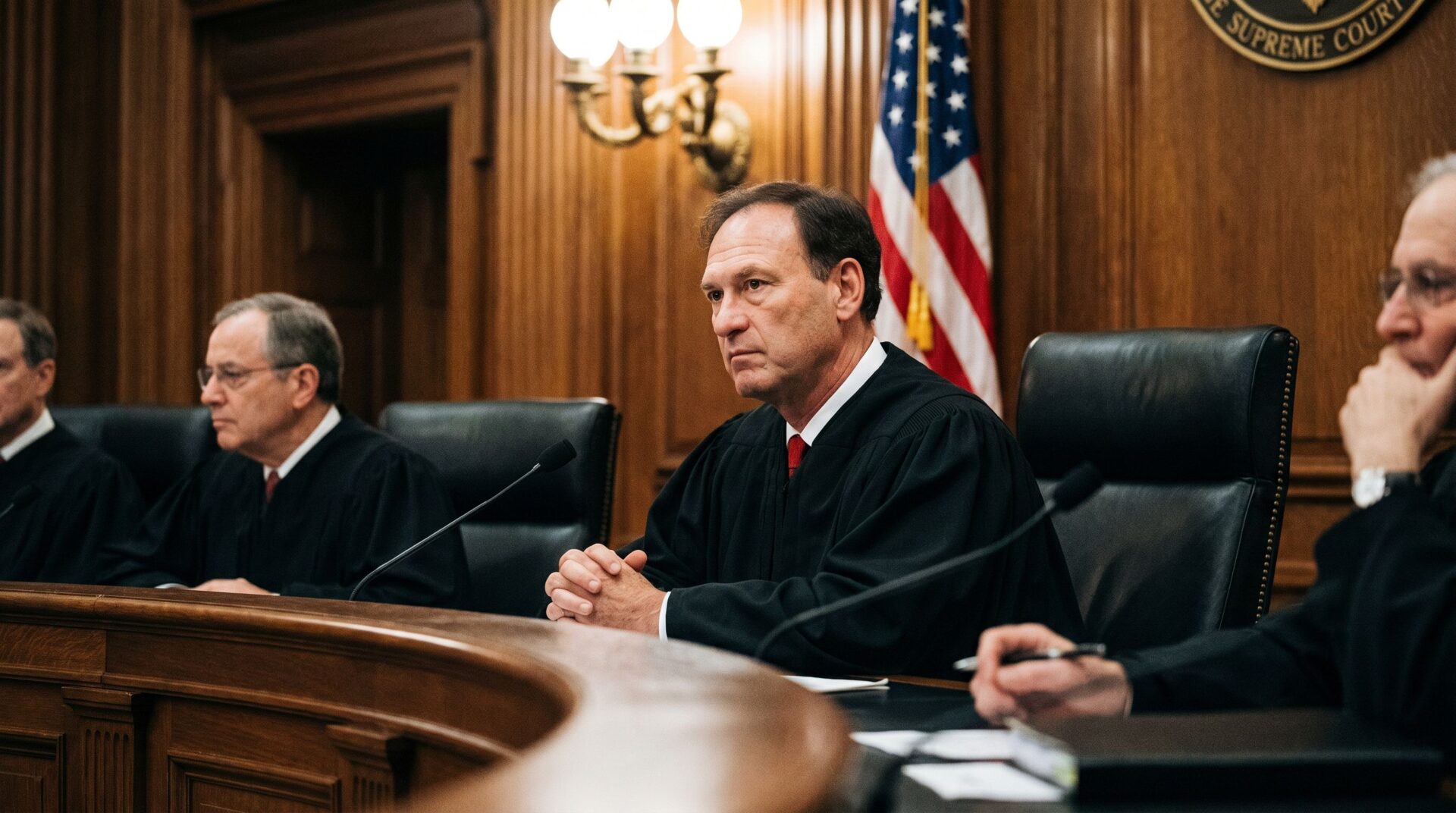
We got treated to a masterclass in judicial demolition this week when Justice Samuel Alito walked into oral arguments at the Supreme Court and did what he does best — asked one simple question that made a leftist lawyer wish he’d called in sick. The case was about Trump’s decision to end Temporary Protected Status for Haitian migrants, and the lawyer strutting up to the podium had one argument in his briefcase: racism. Trump ended TPS because he hates brown people. That was the whole play. One question from Alito, and the entire house of cards folded like a cheap lawn chair in a hurricane.
You almost felt bad for the guy. Almost. Then you remembered he flew to Washington to argue with a straight face that enforcing the word “temporary” in “Temporary Protected Status” is a hate crime, and the sympathy evaporated faster than Biden’s cognitive function after 4 PM.
Here’s what happened. The lawyer — representing groups that want TPS to be a permanent golden ticket rather than the emergency stopgap it was designed to be — stood before the highest court in the land and argued that the Trump administration’s decision to wind down TPS for Haitian nationals was motivated by racial animus. Not policy. Not law. Not the plain English meaning of the word “temporary.” Nope. Racism. Because when you don’t have the law on your side, you play the race card and hope nobody calls the bluff.
Justice Alito called the bluff.
He asked, essentially, whether the lawyer could point to any evidence — any at all — that racial motivation drove the TPS decision, beyond the fact that the affected population happened to be Haitian. That’s it. One question. And the lawyer stammered. He dodged. He pivoted to “broader context” and “statements made in other settings” and all the other euphemisms lawyers use when they mean “I don’t actually have evidence but I’d really like you to assume the worst anyway.”
It was like watching someone try to explain why they were speeding by arguing the road was racist.
But here’s where it gets truly beautiful. While Alito was performing surgery with a scalpel, Justice Sotomayor was over on her side of the bench arguing — and we are not making this up — that the Department of Homeland Security essentially cannot end Temporary Protected Status for Haitians. Cannot. As in, the “temporary” part of the program is decorative. Like the “close door” button on an elevator. It’s there. It looks official. But it doesn’t actually do anything.
A sitting Supreme Court Justice looked at a program with the word TEMPORARY in its name and suggested it should be permanent. She didn’t even try to hide it. She basically argued that once you grant TPS, the government’s hands are tied. You can never, ever take it back. “Temporary” is just a word they slapped on there to make Congress feel better in 1990. The real meaning, according to Sotomayor, is “welcome forever, and if you disagree, you’re probably a bigot.”
This is the left’s entire immigration strategy in one courtroom exchange. Step one: create a “temporary” program. Step two: let it run for decades without review. Step three: when someone finally tries to enforce the “temporary” part, scream racism. Step four: get a sympathetic judge to rule that enforcing the law is unconstitutional because feelings.
We’ve seen this playbook before. DACA was supposed to be a temporary executive action. Obama said so himself. Then it became the third rail of immigration politics that nobody could touch without being called a monster. TPS is the same game. Haiti’s TPS designation has been renewed over and over since 2010. That’s sixteen years of “temporary.” At what point do we just admit the word has lost all meaning? When it hits twenty years? Thirty? When the original applicants’ grandchildren are filing renewals?
The beauty of Alito’s approach is that he didn’t need a speech. He didn’t need a monologue. He needed one question to expose the entire argument as a fraud. The racial motivation claim was never about evidence. It was about intimidation. Call someone racist loudly enough and maybe they’ll back down. Maybe the Justices will get nervous about headlines. Maybe the court of public opinion will override the actual court.
But Alito doesn’t scare. He’s been on the bench long enough to know that the race card is the last refuge of a lawyer who doesn’t have the statute on his side. And when he asked for actual evidence — not vibes, not “context,” not mean tweets from 2017 — the whole thing crumbled.
Meanwhile, we should talk about what TPS actually is, because the media has done a spectacular job of pretending it’s an asylum program. It’s not. Temporary Protected Status was created for people from countries experiencing ongoing armed conflict, environmental disaster, or other extraordinary conditions. The key word — and we really cannot stress this enough — is TEMPORARY. It was never designed to be a backdoor immigration program. It was designed so that people already in the United States didn’t get sent back to an active earthquake zone or a civil war. The idea was always that when conditions improved, the designation would end and people would return home or pursue other legal immigration paths.
But the left figured out a long time ago that if you let a “temporary” program run long enough, people build lives around it. They have kids. They buy houses. They put down roots. And then when someone tries to enforce the law as written, you point to all those roots and say, “See? You can’t possibly uproot these people. That would be cruel.” It’s a trap designed from the start. Create the dependency, then weaponize the dependency.
Alito sees through it. And based on the oral arguments, he’s not the only one.
The left walked into the Supreme Court this week with nothing but a race card and a prayer. Alito took the race card, tore it in half, and handed it back. Sotomayor tried to redefine “temporary” as “permanent” because apparently words don’t mean things anymore when immigrants are involved. And the rest of us got to watch a lawyer learn in real time that “but racism” isn’t a legal argument — it’s a confession that you don’t have one.
One question. That’s all it took. And honestly? It was one more than he needed.