
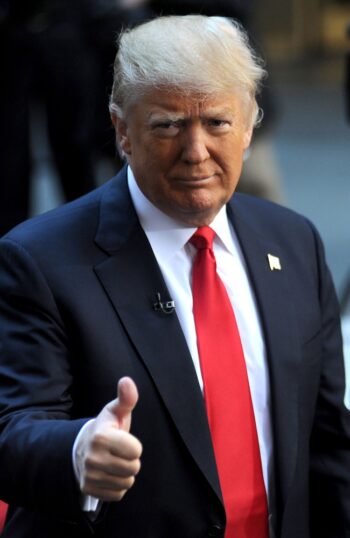
One year ago this week, Donald Trump stood behind a podium and declared April 2nd “Liberation Day.” He slapped a 10% minimum tariff on nearly every country that ships goods to America, with steeper rates on the worst offenders, and he did it using emergency powers that made every free-trade theologian in Washington lose their collective minds.
The reaction was — and I’m being generous here — slightly less restrained than the Hindenburg footage. Goldman Sachs said there was a 45% chance of recession. JP Morgan said 60% chance of a *global* recession. CNN ran a chyron that literally said “ECONOMIC CATASTROPHE.” The S&P 500 dropped 10% in two days. The Nasdaq entered correction territory before most Americans had finished their morning coffee. Six point six trillion dollars in market value vanished. CNBC anchors were doing that thing where they try to look calm but their left eye is twitching.
And now? One year later? The market has rebounded 32% from its April 8th low. It’s sitting near all-time highs. The recession never came. The global economic collapse never materialized. The breadlines that every blue-checkmark economist promised us? Nowhere to be found.
But don’t hold your breath waiting for the apology.
See, here’s what actually happened — and what every single person screaming “economic catastrophe” either didn’t understand or didn’t want you to know. The tariffs worked exactly the way tariffs are supposed to work. They created pressure. They forced negotiations. They made countries that had been robbing us blind for decades suddenly very interested in making a deal.
Remember when Trump paused the reciprocal tariffs above 10% on April 9th for 90 days for everyone except China? The market exploded upward. Not because the tariffs were bad, but because the *leverage* was working. Countries came to the table. Deals got made. And the baseline 10% tariff stayed in place, which is exactly what Trump wanted from the beginning — a floor that says “if you want access to American consumers, you’re going to pay for the privilege.”
The media didn’t cover any of that. They covered the panic. They covered the drop. They covered the Goldman Sachs recession prediction like it was gospel from Mount Sinai. And when the market recovered — when it surged past where it started — they just quietly moved on to the next apocalypse.
This is what they do. Every single time Trump makes a bold economic move, the playbook is identical. Step one: predict doom. Step two: find the scariest possible number and put it on screen. Step three: interview six former Obama economists who all agree we’re headed for a depression. Step four: when none of it happens, pretend you never said it.
Remember when the tax cuts were going to “blow up the deficit and crash the economy”? Remember when pulling out of the Paris Climate Accord was going to make America an “economic pariah”? Remember when renegotiating NAFTA was going to “destroy trade with our closest allies”? How’d all those predictions work out?
The pattern is so obvious by now that it’s almost boring. Almost. Except it keeps working on the same people. The same coastal elites who panic-sold their portfolios on April 3rd last year and then had to buy everything back at higher prices two months later. The same media outlets that run “IS THIS THE END?” headlines every time Trump touches trade policy. The same economists who’ve been wrong about this president since the escalator ride in 2015.
Here’s what they’ll never admit: the American economy is more resilient than they want it to be. American workers are more adaptable than the models predict. And American manufacturing — the sector that was supposed to be dead and buried — is showing signs of life that nobody in the Ivy League economics departments saw coming.
Now, are tariffs painless? No. Nobody said they would be. Some prices went up. Some supply chains had to adjust. Some companies that had spent 30 years shipping every last job to China had to actually rethink their business model. Tough. That’s not a bug. That’s the feature. The entire point was to make it more expensive to offshore American jobs and more attractive to build things here.
And a year in, that’s exactly what’s happening. Not overnight. Not in some dramatic factory-opening montage. But slowly, steadily, in the way that real economic shifts actually work — one decision at a time, one factory at a time, one company at a time deciding that maybe, just maybe, it makes sense to build it in Ohio instead of Shenzhen.
The anniversary of Liberation Day should be a moment of reckoning for every pundit, every economist, every anchor who looked into a camera twelve months ago and told you the sky was falling. They were wrong. Spectacularly, measurably, undeniably wrong. The market is up. Jobs are strong. The recession never came.
But they won’t reckon with it. They’ll just wait for the next tariff announcement and do the whole song and dance again. Because that’s all they know how to do.
Happy anniversary, Liberation Day. You scared the hell out of Wall Street, made the media look like fools, and the economy is doing just fine. Again.