
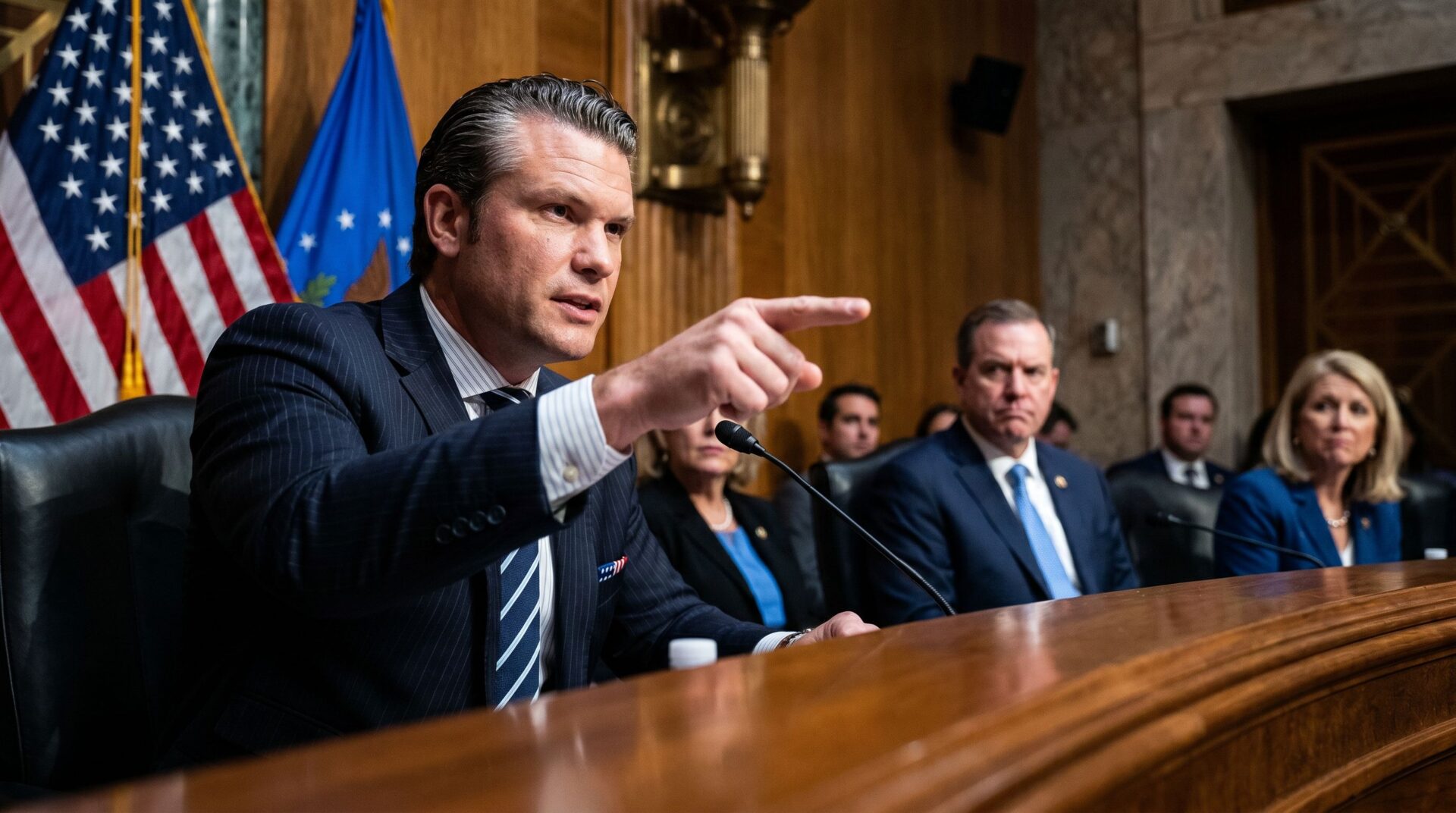
Defense Secretary Pete Hegseth sat down in front of the House Armed Services Committee on Wednesday for his first congressional testimony since the Iran war started two months ago. Democrats had been sharpening their knives for weeks. They had talking points. They had rehearsed their outrage faces. They had cable news hits scheduled for immediately after.
It did not go the way they planned.
Hegseth opened by identifying the biggest threat to the mission — and it wasn’t the Iranian Revolutionary Guard. “The reckless, feckless and defeatist words of congressional Democrats and some Republicans” are the real adversary right now, he told the committee. You could actually hear the air leave the room. A Secretary of Defense just walked into Congress and told half the people sitting across from him that they were the problem. Beautiful.
“Two months in, on an existential fight for the safety of the American people, Iran cannot have a nuclear bomb — we are proud of this undertaking,” Hegseth said in his opening remarks. Short. Direct. No apologies. No hand-wringing about “stakeholder concerns” or whatever phrase the Pentagon’s PR department usually cooks up.
Now here’s where it got fun.
Ranking Democrat Adam Smith — the guy whose entire job is to be the opposition’s top voice on military matters — tried to spring a trap. He pointed out that Hegseth had said Iran’s nuclear facilities were “obliterated” during the 2025 strikes. So why, Smith demanded, did we need to start a whole war if the nuclear threat was already dealt with?
“We had to start this war, you just said 60 days ago, because the nuclear weapon was an imminent threat,” Smith said, practically vibrating with gotcha energy. “Now you’re saying that it was completely obliterated?”
Hegseth didn’t flinch. Iran “had not given up their nuclear ambitions” and still had thousands of missiles pointed at American allies and interests across the region. You blow up the lab, the scientist doesn’t stop wanting to build the bomb. That’s not a contradiction — that’s how reality works. But nuance isn’t really Adam Smith’s thing when there’s a CNN segment waiting.
Then California’s own John Garamendi — a man who has never met a camera he didn’t love — went on television that same morning and called the whole operation a “quagmire.”
A quagmire. Two months in.
Hegseth caught wind of it and was not impressed. He told the committee that comparing this operation to the twenty-year disasters in Iraq and Afghanistan was “premature and unfair to U.S. troops.” Those conflicts, he said, were marked by years of unclear missions and failed nation-building. This one has a clear objective: Iran does not get a nuclear weapon. Period.
He also told Garamendi he “should know better.” (He shouldn’t. He doesn’t. But it was a nice thing to say.)
The cost question came up, of course. Pentagon comptroller Jules Hurst told lawmakers the war has run about $25 billion so far, mostly in munitions. Democrats gasped like they’d never seen a defense budget before. Twenty-five billion sounds like a lot until you remember that these same people spent $80 billion on IRS agents, $7.5 billion on EV chargers that built exactly seven stations, and whatever ungodly sum went to Ukrainian pension funds last year.
We’re spending $25 billion to make sure the world’s leading state sponsor of terrorism doesn’t get a nuclear weapon. That seems like a bargain compared to the alternative — which is an Iran with a nuke and the leverage to hold the entire Middle East hostage forever.
Democrats also dusted off the War Powers Resolution, because nothing says “we support the troops” like threatening to yank them out of a fight before they finish the job. The 1973 law requires congressional approval for conflicts lasting more than 60 days, with a 30-day withdrawal window. So the clock is ticking toward June, and Democrats are already drafting their “we told you so” press releases.
They’re not wrong about the law — Congress does have that authority. But the timing tells you everything about their priorities. They don’t want to debate strategy. They want a vote they can campaign on. “I voted to end the war” looks great on a bumper sticker. It looks less great when Iran tests a nuclear weapon six months later.
Meanwhile, Hegseth sat there and took every question. He interrupted Democrats when they tried to filibuster their own five-minute windows with speeches instead of questions. He didn’t grovel. He didn’t hedge. He didn’t do the pathetic Washington thing where you apologize for existing and promise to “look into it” and “get back to the committee.”
He gave them the same energy he’d give a bad take on Fox & Friends — except this time it was under oath, on camera, in the United States Capitol.
The $1.5 trillion defense budget Hegseth brought with him is historic — the largest ever proposed. Democrats hate it, naturally, because they’d rather spend that money on free college for illegal immigrants or whatever the progressive wish list looks like this week. But if you’re going to fight a war, you fund the war. That’s not complicated.
Here’s the bottom line: Pete Hegseth is a combat veteran who went to Congress and told a room full of politicians — most of whom have never heard a shot fired in anger — that their armchair quarterbacking is doing more damage than Iranian missiles. And he said it to their faces.
That’s the kind of Defense Secretary we’ve needed for about thirty years. Welcome to the show, Democrats. The guy across the table isn’t going to cry when you raise your voice.