
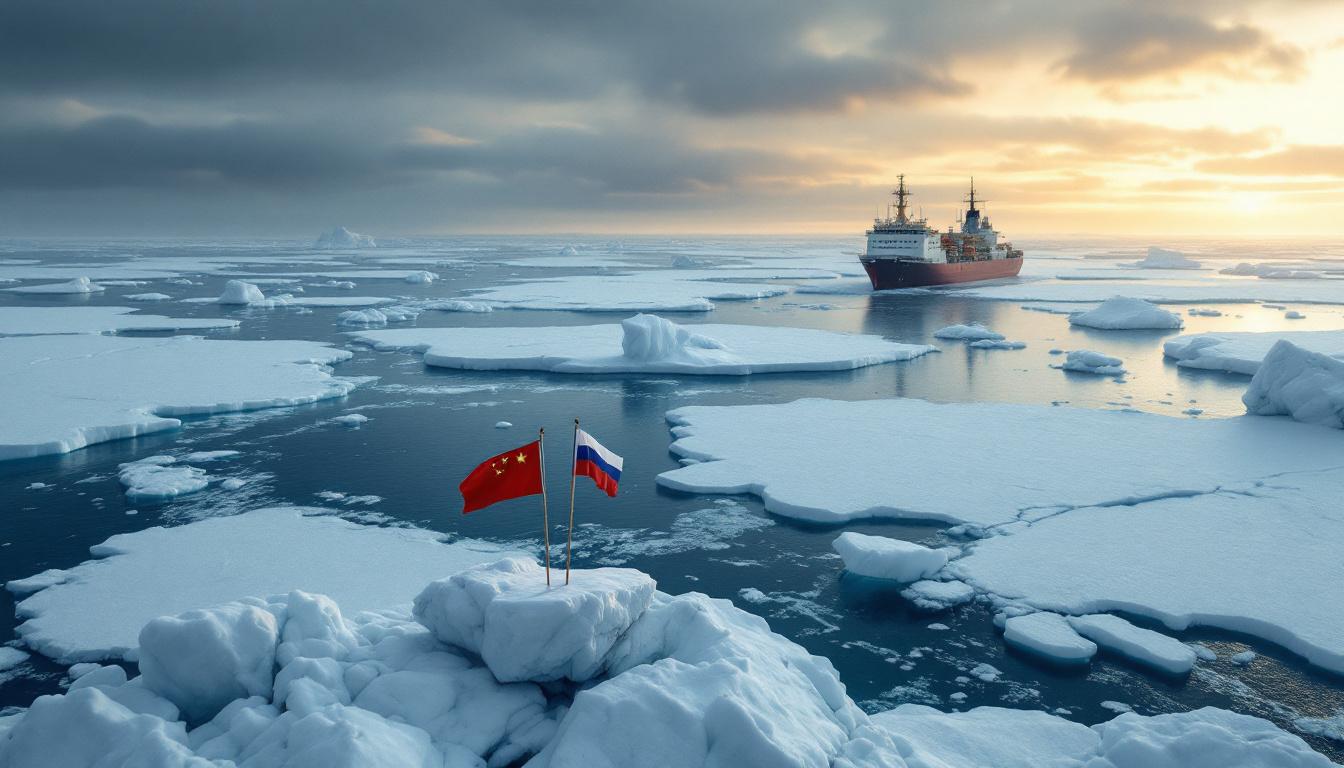
There's a border crisis nobody's talking about — and it's at the top of the world. While we've spent the last few years obsessing over our southern border (rightfully so), Russia and China have been quietly waging a legal war to seize control of the Arctic, and a devastating new analysis from War on the Rocks lays out exactly how far they've gotten.
But sure, let's have another Congressional hearing about TikTok dances. That'll fix it.
The analysis, authored by Jill Goldenziel, a professor at the National Defense University's College of Information and Cyberspace, alongside U.S. Navy judge advocate Kathy Paradis and Arctic policy advisor Kathryn Bryk Friedman of the Ted Stevens Center for Arctic Security Studies, paints a picture that should make every American's blood boil. Russia and China aren't sending troops to the Arctic — they're sending lawyers. They're manipulating international law, twisting the United Nations Convention on the Law of the Sea — UNCLOS — and exploiting institutions to stake claims on territory and shipping lanes that could reshape global power for the next century.
Here's the short version: Russia has drawn illegal "straight baselines" around its Arctic archipelagos, recharacterized international straits as its own internal waters, and slapped navigation restrictions, mandatory Russian ice pilot escorts, and tariffs on anyone trying to use the Northern Sea Route. They've essentially hung a "NO TRESPASSING" sign on international waters and dared anyone to do something about it.
And China? The country that's roughly as close to the Arctic as Florida is to Canada now calls itself a "near-Arctic state." That's like me calling myself a near-billionaire because I once found a twenty in a parking lot. Beijing launched its "Polar Silk Road" initiative, and in September 2024, a Chinese icebreaker completed a transit of the Northern Sea Route. By 2025, Russia was openly training Chinese seafarers to navigate polar waters. The two countries are developing something called the "Trans-Arctic Transport Corridor" together — cutting transit times to just 14 to 20 days and giving China preferential access to a route that bypasses Western-controlled chokepoints.
The lawfare angle is where it gets really ugly. When the U.S. announced its extended continental shelf claim in 2023 — a claim extending beyond the standard 200 nautical miles under UNCLOS Article 76 — Russia and China coordinated a legal counterattack. Russia accused the United States of "unilaterally trying to reduce the area of the seabed," and China released a formal denunciation in April 2024 calling the U.S. claim "illegal and invalid." Two authoritarian regimes, lecturing us on international law. The irony writes itself.
Meanwhile, Russia's shadow fleet — vessels with spoofed Automatic Identification System signals — is running through these waters evading sanctions. And remember those undersea cable incidents in the Baltic Sea in 2024 and 2025? The ones that NATO had to launch its Baltic Sentry mission to address? Yeah, those are suspected Russian operations too. But attributing attacks on undersea infrastructure is nearly impossible under current international law, which is exactly how Moscow likes it.
Gen. Gregory Guillot, the U.S. Northern Command commander, knows the stakes. The 2025 National Security Strategy flags Arctic competition. But knowing and doing are two very different things, and Washington has a long, embarrassing history of knowing about a problem and doing absolutely nothing until it's too late.
The authors put it bluntly: "What happens when the Arctic starts to look like the South China Sea?" We already know the answer to that one. China built fake islands, militarized them, and the world said "tsk tsk" and moved on. Now they're running the same playbook at the top of the globe with Russia as their partner.
We're not talking about some frozen wasteland nobody cares about. The Arctic holds massive energy reserves, critical shipping lanes, and strategic military positioning that affects everything from U.S. European Command to U.S. Indo-Pacific Command. Overlapping continental shelf claims from the U.S., Russia, Denmark through Greenland, and Canada mean this is a four-way land grab — except only two of those countries are playing to win.
While our politicians were busy investigating each other and virtue-signaling on social media, Russia and China built a legal framework to steal the top of the world. And if we don't wake up fast, we're going to find out what happens when America loses a border it didn't even know it had.